
 Facebook
 X
X LinkedIn
 Forward
Linked: Breathing & Postural Control
Formerly known as: "If You Can't Breath, You Can't Function"
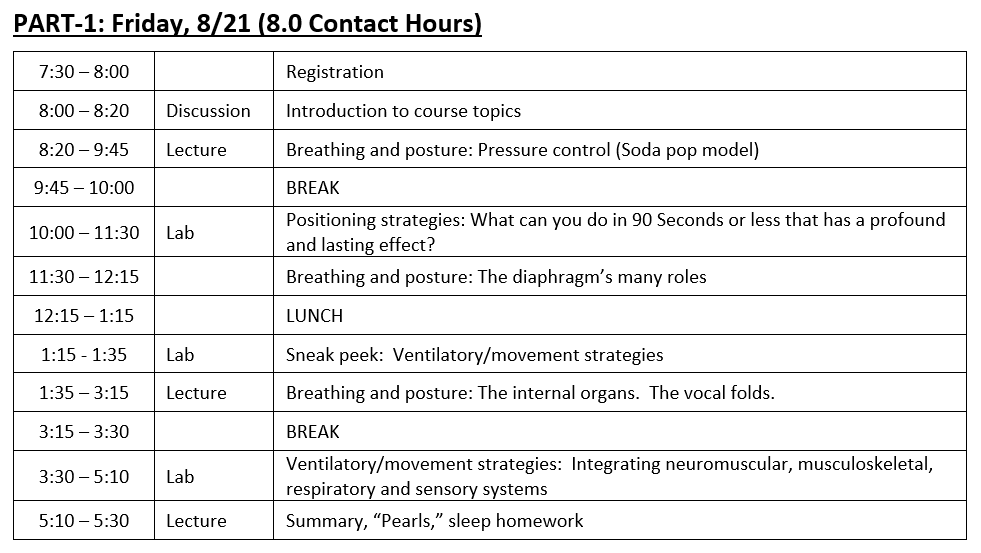
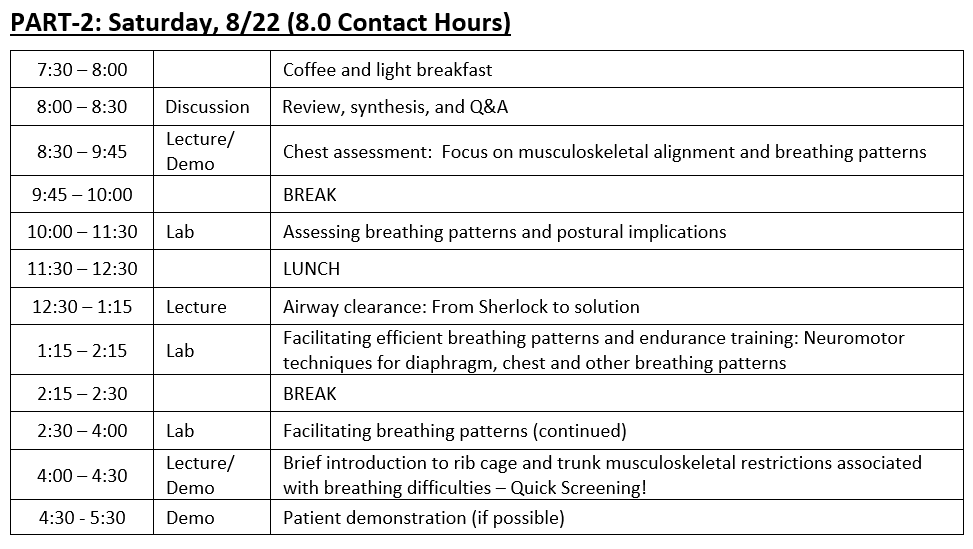
This course, developed by Mary Massery, proposes a new definition of “core stability;” redefining it as the dynamic control of trunk pressures to optimize postural stability (balance). Dr. Massery’s “soda pop can model” links breathing mechanics to postural control using multi-system interactions. The speaker presents novel research demonstrating the role of vocal folds as postural stabilizers, extending the concept of “core stability” from the vocal folds on the top of the trunk to the pelvic floor on the bottom. In Part-1, foundational information and quick interventions will be the focus (positioning and ventilatory strategies). In Part-2, the focus shifts to hands-on techniques: assessing “normal” breathing patterns, and learning neuromotor breathing retraining techniques and manual assistive cough techniques. Multiple clinical cases will be used to cement the concepts. The course is applicable for any pediatric or adult patient (or therapist) who breathes!
Parts 1 (Day 1) & 2 (Day 2-3)
Theory and hands-on labs
(Three days: 21.0 Contact Hours)
Learning Objectives
At the conclusion of Part-1 (Day-1), participants should be able to:
- Relate trunk pressures to breathing and postural control using the Soda Pop Can Model.
- Identify the multiple, simultaneous roles of the diaphragm as related to breathing, postural control, gastroesophageal reflux, constipation, and venous return.
- Correlate the role of the vocal folds in normal postural stability responses (balance) and make the case for using speaking valves for patients with tracheostomies.
- Choose the best client positions using simple equipment (towels, pillows, abdominal binders, etc) for optimal physiological and biomechanical support of breathing.
- Utilize a ventilatory strategy algorithm presented in class to optimally match breathing with movements from bed mobility to athletic endeavors.
- Apply concepts to a wide variety of patient populations from infancy to geriatrics.
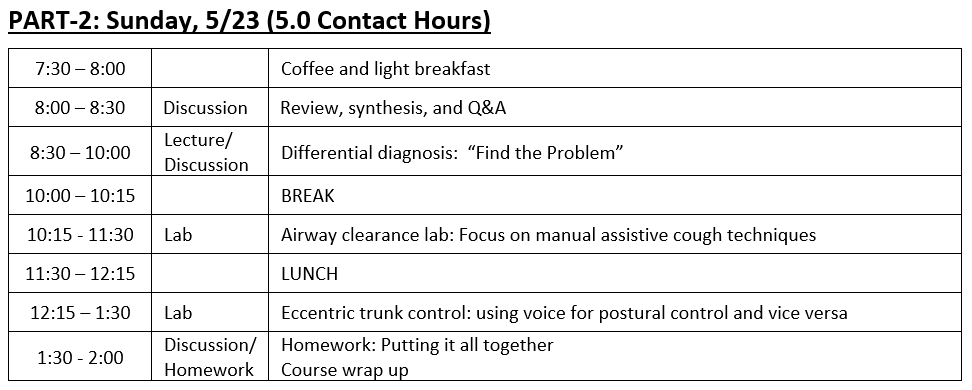
At the conclusion of Part-2 (Days 2- 3), participants should be able to:
- Utilize a multi-system approach to evaluating motor impairments.
- Identify the variations of “normal” breathing patterns and discuss the efficiencies/inefficiencies for individual patient conditions.
- Evaluate need for, and demonstrate, appropriate neuromotor retraining techniques for patients with ineffective breathing/postural control strategies (health or participation deficits).
- Participate in a live patient demonstration (if a patient is available) and suggest possible evaluation and treatment ideas based on the course material.
- Design a targeted airway clearance program using the principles of mobilization, expectoration and oral management.
- Demonstrate airway clearance techniques, with an emphasis on manual assistive cough techniques, and apply an airway clearance algorithm to specific patient conditions.
- Identify thoracic cage/spine restrictions as they pertain to breathing mechanics and postural control (a very brief introduction of chest wall restrictions).
- Evaluate the need for, and demonstrate, neuromotor retraining techniques to improve breath support for voicing and postural control (eccentrics).
- Suggest immediate ways to incorporate the concepts into therapy activities in your clinical setting.
Please note this event is in-person only without a virtual attendance option.
Speaker Biography
Mary Massery, PT, DPT, DSc
Dr. Massery received her BS in Physical Therapy from Northwestern University in 1977, her DPT from the University of the Pacific in 2004 and her DSc from Rocky Mountain University in 2011. Her publications and interests focus on linking motor behaviors to breathing and/or postural mechanics in both pediatric and adult patient populations. Dr. Massery has been invited to give over 1,000 professional presentations in all 50 US states and in 18 countries worldwide, including more than 100 presentations for the American Physical Therapy Association. Mary’s research pioneered the concept of managing trunk pressures as a new way to visualize core stabilization. She has delivered keynote and major addresses on topics such as cystic fibrosis and posture, pectus excavatum (chest deformities), connections between posture & breathing, and PNF (proprioceptive neuromuscular facilitation).
Mary has received national awards from the APTA, including its highest clinical award, The Florence Kendall Practice Award, honoring “one’s outstanding and enduring contributions to the practice of physical therapy." She has been honored as Outstanding Alumnus of the Year by each of her 3 universities. She was also awarded Northwestern University’s Alumnae Research Achievement Award. Mary continues to maintain a private practice in Chicago, specializing in breathing and postural dysfunction.
Others
A general certificate of attendance will be available after the completion of the online evaluation. Claim only credit commensurate of your conference attendance.
Available Credit
- 21.00 APTA
- 21.00 Attendance
- 5.25 Approved AMA PRA Category 1 Credit™