
 Facebook
 X
X LinkedIn
 Forward
Audiology, Speech-Language Pathology and Learning Conference - Emergent Literacy Interventions for Pediatric AAC Users with Extensive Support Needs - Sofia Benson-Goldberg, PhD, CCC-SLP
Overview
Children and adolescents who cannot use speech to be heard and understood require access to literacy, specifically spelling and writing, as a means of communicating precisely what they want, to whom they want, when they want. Learning the literacy skills required to support this precise communication requires a range of opportunities to learn emergent language and literacy skills and concepts.
At a minimum, this includes opportunities to develop conceptual knowledge about the functions of print; procedural knowledge related to letters, sounds, and words; oral language understanding and use; and metalinguistic skills related to phonological and syntactic awareness (National Early Literacy Panel [NELP], 2008; Sénéchal et al., 2001). Without these emergent literacy skills, students struggle to learn and apply conventional literacy skills (i.e., the ability to read independently with comprehension and write to convey meaning to others; Connor et al., 2006).
Though most students acquire emergent skills and concepts before or shortly after beginning kindergarten, many students who use AAC, especially those with extensive support needs, require instruction throughout their school career to acquire them (Burnes & Clark, 2021). This workshop will offer an instructional framework and practical approaches to address the emergent literacy learning needs of children who are not able to rely solely on speech to be heard and understood. The focus will be on comprehensive approaches to emergent literacy with an emphasis on application and use rather than skill mastery.
Target Audience
Audiologists, Speech-Language Pathologists, Learning and Health Professionals
Learning Objectives
At the end of the conference, participants will be able to describe:
• Three or more distinctions between emergent and conventional literacy instruction.
• Three or more critical conditions of successful emergent literacy and communication instruction.
• Three or more ways to integrate symbolic communication intervention into emergent literacy instruction.
Additional Information
| Attachment | Size |
|---|---|
 ASL.BROCHURE.2026.FINAL_.pdf ASL.BROCHURE.2026.FINAL_.pdf | 1 MB |
Course summary
- 0.65 ASHA
- 6.50 Attendance
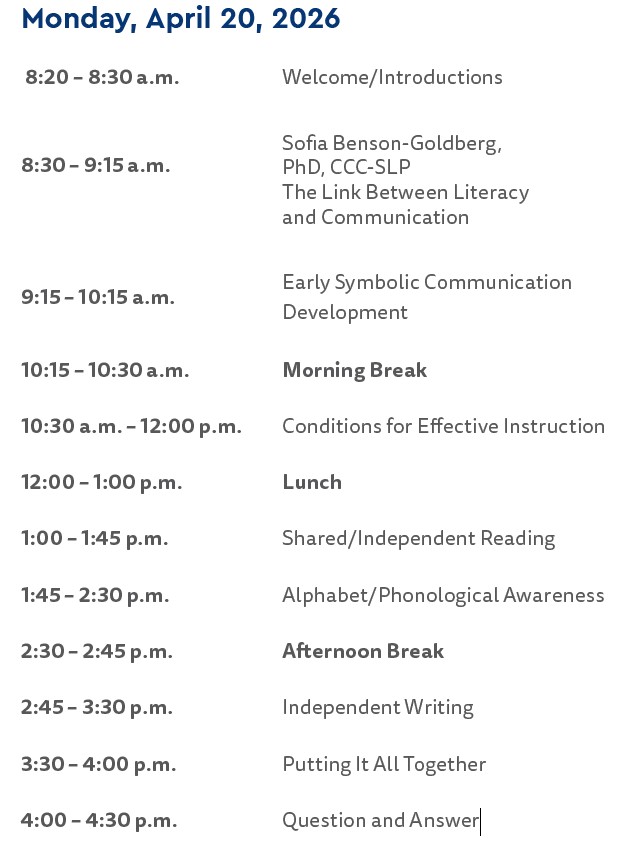
Hybrid Format - Live In-Person or Virtual - Select location with registration type.
2nd Floor Conference Center - Mt. Oxford Auditorium
Free Parking: Conference participants MUST park in Visitor Lot #10 - accessible from Victor Street entrance only. Do NOT park in the patient parking structure.
Please allow plenty of time to park and pre-screen at main entrance.
Sofia Benson-Goldberg, PhD, CCC-SLP, is an Assistant Professor in the Communication Disorders and Sciences Program at the University of Oregon. Prior to Oregon Dr. Benson-Goldberg was a postdoctoral research associate at the Center for Literacy and Disability Studies at the University of North Carolina at Chapel Hill. Dr. Benson-Goldberg’s research and clinical interests focus on the language, communication, and literacy experiences of individuals who are non-speaking and use augmentative and alternative communication (AAC) systems. She is particularly interested in how to improve access to reading and writing instruction and intervention for individuals with high support needs who use AAC. Dr. Benson-Goldberg is a nationally-certified Speech-Language Pathologist who has worked with children, adolescents, and young adults who use AAC and their families in home-based, clinical, and school settings.
Faculty Disclosure:
Financial: Dr. Benson-Goldberg received financial compensation via an honorarium and reimbursement for travel-related expenses. She has no additional financial or non-financial relationships to disclose.
Non-financial: None
Planners, faculty, and others in control of content (either individually or as a group) have no relevant financial relationships with ineligible companies.
Children’s Hospital Colorado is approved by the Continuing Education Board of the American Speech-Language-Hearing Association (ASHA) to provide continuing education activities in speech-language pathology and audiology. See course information for number of ASHA CEUs, instructional level and content area.
ASHA CE Provider approval does not imply endorsement of course content, specific products or clinical procedures.
This program is offered for 0.65 ASHA CEUs (Intermediate level; Professional area).
Attendees are expected to be present for the entire program. Individuals who are not present for the full program will not receive ASHA CEUs. No partial credit will be provided.
A general certificate of attendance will be provided to all others, with completion of the evaluation.
Learners should complete their learner bios with ASHA ID and associated requirements for reporting.
Available Credit
- 0.65 ASHA
- 6.50 Attendance
Price
If you are an ASHA Professional Board Member and want CEU's, update your profile "My Account/My Profile" on this site. If your profile is not updated by the date of the event, you will not be eligible for ASHA CEU's.
Required Hardware/software
Educational format is Hybrid.
Virtual learners should have audio-video capabilities. Virtual link provided 1-2 days prior to the course.
Cancellation Policy
A refund, minus a $25 processing fee will be granted if cancellation is requested by April 13, 2026. No refunds will be granted after this date or for non-attendance, although you may send a substitute.
The Planning Committee reserves the right to modify the agenda content while keeping consistent the time and content requirements for ASHA CEUs, or cancel this conference, or if minimum acceptable registration is not attained by April 13, 2026, with a full refund to participants.